Fleet expense control: from manual to automation to cut costs intelligently
Understand how fleet expense control evolves from spreadsheets to automated solutions, reducing costs and increasing operational efficiency.

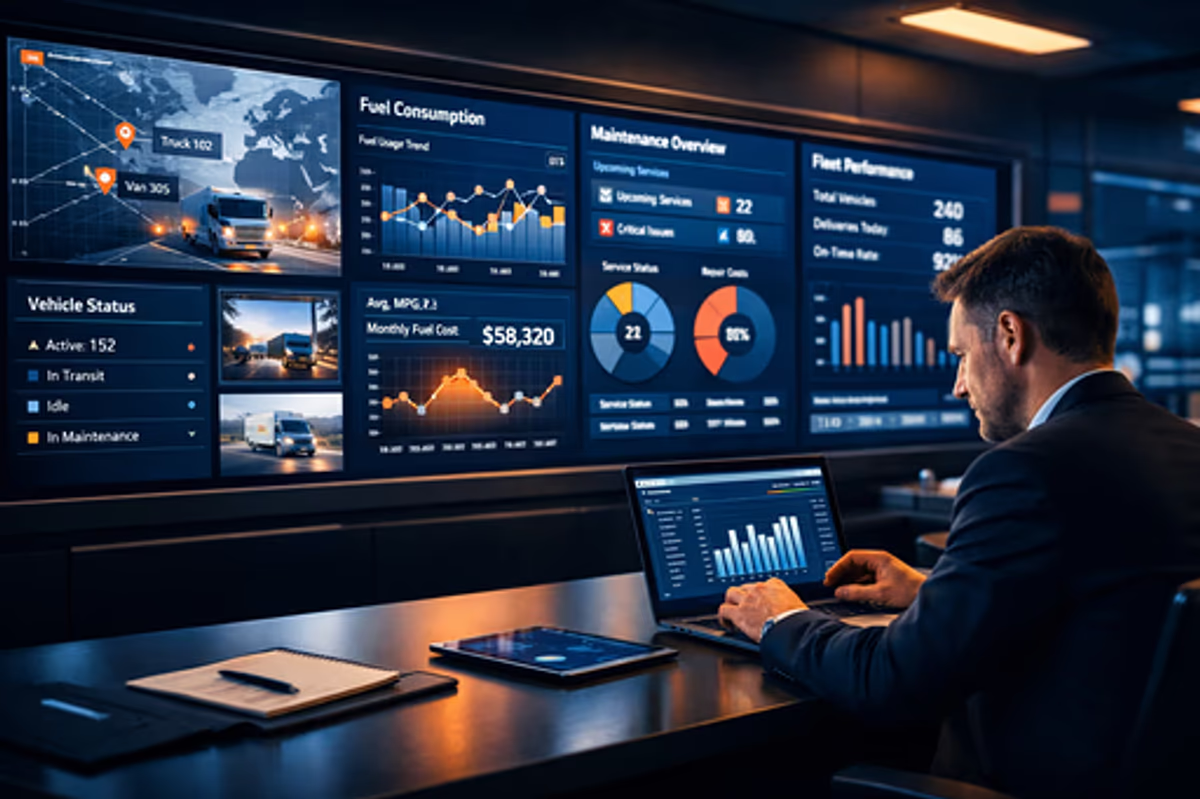
Managing the costs of a fleet is one of the biggest challenges faced by companies and public agencies. Fuel, maintenance, tolls and other operational expenses add up quickly, directly impacting the budget and the efficiency of the operation.
For many organizations, the first step in this control begins with the use of spreadsheets. This approach makes it possible to organize information and provide an initial view of costs, serving as an important starting point to move away from a lack of control.
However, as the operation grows, the limits of manual management begin to show.
Why expense control is essential
Without a clear view of costs, it becomes practically impossible to make strategic decisions. The lack of control creates recurring problems:
- Difficulty identifying high-cost vehicles
- Decentralized and inconsistent data
- Budget surprises at the end of the month
- Inefficiency in the operation
- Waste that goes unnoticed
As highlighted in the market, centralizing this information is the first step to transforming fleet management.
The limit of spreadsheets in fleet management
Although useful at first, spreadsheets have critical limitations:
- They depend on manual entry
- They are subject to errors and oversights
- They do not offer a real-time view
- They do not generate alerts about problems
- They make it hard to scale the operation
In practice, they show what has already happened, but they do not help the manager act at the right moment.
The evolution: from organization to intelligence
Modern fleet management requires more than recording — it requires analysis, predictability and action.
This is where automated solutions come in.
With the use of technology, it is possible to turn operational data into strategic information, enabling:
- Real-time monitoring
- Immediate identification of deviations
- Centralized control of the operation
- Reduction of operational costs
- Faster, more assertive decision-making
How automation transforms the operation
Automation eliminates manual tasks and integrates all information into a single environment.
In practice, this means:
A complete view of the operation
All data on fueling, maintenance and vehicle use is centralized.
Smart alerts
The manager is notified about deviations, excessive consumption or out-of-pattern situations.
Cost analysis per vehicle
Allows you to understand exactly where the biggest expenses are and act with precision.
Continuous efficiency
The operation stops being reactive and becomes strategic.
The role of technology in the new management
Solutions like Bamex's make it possible to integrate fueling, maintenance, telemetry and tracking on a single platform, offering a complete and reliable view of the operation.
This not only reduces costs but also increases predictability and improves the performance of the fleet as a whole.
Far beyond control
The evolution of management lies not only in technology, but in how it is applied.
The goal is not just to record expenses, but to turn data into decisions, eliminating waste and creating a more efficient operation.
Starting with a spreadsheet is an important step. But staying in manual management limits the growth and efficiency of the operation.
Companies that evolve to automated management manage to reduce costs consistently, increase control and make decisions with more confidence.
In today's scenario, efficiency is not just about controlling — it is about anticipating, analyzing and acting intelligently.
Simplify your fleet management with Bamex
Fueling, maintenance, tolls, tracking and benefits on a single platform. Talk to us and find out how.